
Small business owners are practical buyers. They wear many hats – tracking clients, managing inventory, understanding their numbers – and they are short on time. They want organizational solutions without paying enterprise software prices or building something from scratch. That’s the gap your business spreadsheet can easily fill in. Let’s see profitable business spreadsheets to sell on Etsy.
Business spreadsheets also tend to command higher prices than personal use templates. A freelancer or business owner understands the value of a tool that saves them two hours a week. They are not comparing prices, they are comparing it to the time cost of building one themselves, or the subscription cost of a proper CRM.
For the bigger picture of what sells in every spreadsheet category, the full Google Sheets ideas guide covers all niches. This post focuses on business products specifically.

Why Business Spreadsheets Are Worth Selling
In one word – because these command higher prices!
I have more than a decade experience of creating spreadsheets in my previous job. I started selling personal use spreadsheets on Etsy. On a whim, I added business spreadsheet, and it sold much better than previous one.
This told me, business owners are better buyers, don’t hassle about prices, and see these smartly created spreadsheets as business expense, not something they need to justify. They know their time is more valuable than creating something from scratch or hassling about the prices.
Another reason business owners make better buyers is, they understand these spreadsheets solve a real problem. Smart business owners know they are stretched in many directions, and need organizational tools.
Business administration is not seasonal. A freelancer needs to track their clients in January the same way they do in July. Business tools join finance trackers as the most reliably evergreen spreadsheet category on Etsy.
Business Planners & Trackers

These are the core business spreadsheet products with broad appeal across many business types. Since these target general businesses, these have higher competition than niche products. But they also have higher search volume and a wider buyer pool. You can build these as your foundation, then use niche products to capture more specific buyers.
1. Small Business Income and Expense Tracker
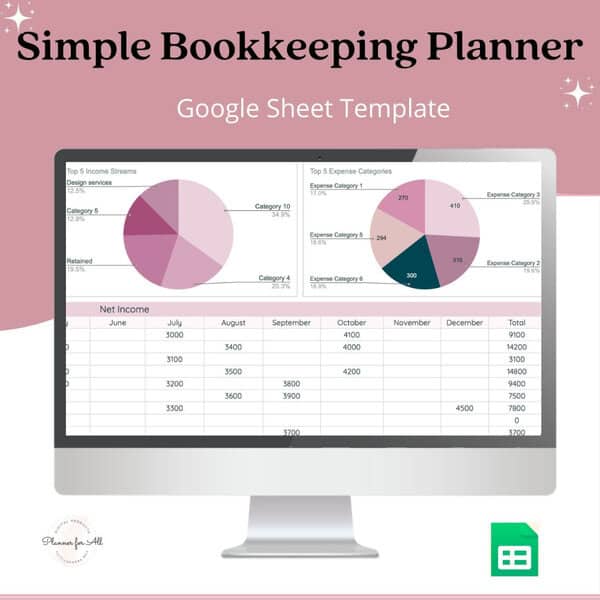
Bookkeeping planner/tracker is probably the most searched business product on Etsy. Every small business owner including freelances, solopreneurs, handmade sellers, salon owners, need it for tax purposes. As this is a generic business term, it also brings higher level of competition.
What to include: You want to include monthly income log by source, expense categories with tax-deductible flag, profit and loss summary, quarterly estimated tax calculator (set-aside percentage), year-to-date totals dashboard, and a mileage log tab. You can also include annual summary dashboard which helps them to know their current annual revenue and expenses.
Why it sells: Every self-employed person legally needs to track income and expenses. This is not a nice-to-have, but a compliance requirement.
2. Client and Customer Tracker (CRM)

Small businesses dealing with clients need a systematic way of organizing their client pipeline. They want to keep track of client contacts, stages, what they’ve committed and remaining work. Service based business owners like website designers, consultants, and anyone else who works with clients need a way to manage an ongoing client list without paying for CRM software.
What to include: Include client name and contact details, service or project type, status (lead, active, completed), communication log with date and notes. You can also include invoice tracking with paid and outstanding amounts, next follow-up date reminder, and a monthly revenue summary by client.
Why it sells: This product fits between sticky note and proper CRM. Small business owners with 5–25 active clients cannot justify Salesforce or other enterprise level CRM but have outgrown tracking clients in their head. A Google Sheets CRM gives them a real system at a one-time price.
3. Inventory Tracker
While we digital product owners don’t need to keep track of inventory, physical and handmade business sellers need to keep record of their inventory. The inventory tracker spreadsheet is used by handmade sellers, resellers, boutique owners, makers, craft businesses or anyone who sells physical products and needs to track stock levels.
What to include: Make sure to include product with SKU, current stock level, reorder threshold with automatic low-stock alert, supplier contact and lead time, cost price and selling price. You can also include monthly stock movement log, and a top-selling products summary.
Why it sells: For physical products, running out of stock means lost sales while overstocking ties up cash. A well-built inventory tracker with automatic low-stock flagging gives product-based business owners the control they need without a dedicated inventory management system.
4. Project Management Tracker

A well-designed project management tracker helps freelancer to keep track of their ongoing projects.Project management tools like Asana or Monday cost $10–$20 per month whereas a Google Sheets alternative at a one-time price is genuinely attractive. This is perfect for anyone who needs to see the status of all their work in one place without paying for project management software.
What to include: Project list with client name, start date, deadline, current status, assigned tasks with completion checkbox, milestone tracker, time log, invoicing status, and a dashboard showing active projects, upcoming deadlines, and overdue items.
Why it sells: A well-designed project management tracker is like a command center for a freelancer balancing five different projects at the same time. It helps them to stay organized and provide timely response and service to their clients.
5. Business Expense and Mileage Tracker
Any self-employed worker, freelancer, or anyone who drives for business and wants to claim the tax deduction. Mileage tracking is one of the most commonly missed deductions among small business owners. A tracker that makes this effortless and shows the cumulative deduction building up, has a clear financial return that makes the purchase obvious.
What to include: Include purpose of the visit, date, start and end location, miles driven, running mileage total, automatic deduction calculation based on current IRS standard mileage rate, business expense log organized by category, and a quarterly summary tab.
Why it sells: The IRS mileage deduction was worth 67 cents per mile in 2025. A self-employed person who drives 5,000 business miles annually is leaving $3,350 in deductions unclaimed if they do not track it. A well-designed tracker will help them to track and claim this deduction.
6. Annual Business Planner and Goal Tracker

This is perfect for small business owners doing annual planning – setting revenue goals, planning launches, organizing quarters. This is more than just business bookkeeping tracker, but involves overall business planning with goals, tasks, offers, and alignment.
What to include: An annual business planner has to have an annual revenue and profit goals. You can also include quarterly or monthly revenue breakdown, priority task list for each quarter, and a launch calendar for new products or services.
Why it sells: Business owners who take planning seriously buy this kind of tool every year. It is a premium product with a premium price point because it serves serious buyers. The annual cadence also makes it a natural repeat purchase, a buyer who uses it this year is likely to buy again next year for a refreshed version.
8. Launch Planner and Product Launch Tracker
While inventory tracker was targeted for physical products businesses, this is perfect for digital product creators, course launchers, online business owners planning structured product launches.
What to include: Make sure to include pre-launch timeline with week-by-week tasks, audience building tracker, launch week schedule, sales goal vs. actual tracker, promotional calendar across platforms, affiliate or partner coordination log, post-launch analysis tab. Also include a lessons learned section and improvement for next launch.
Why it sells: Launching a new product or service is stressful. Doing a disorganized launch causes missed deadlines, gaps in promotion, and no learning to see what worked and what didn’t. A launch planner that gives structure to what is otherwise a chaotic process has clear value to buyers who have been through a messy launch before.
9. Content Calendar and Social Media Planner
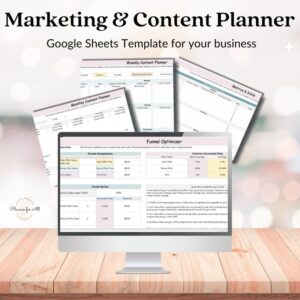
Another product perfectly aligned for content creators or online business owners – content calendar and social media planners. This is perfect for people who want to plan their content across different platforms without relying on a paid tool.
What to include: Make a monthly content calendar grid by platform. You can also include post status, monthly engagement summary, and a content ideas log for capturing inspiration.
Why it sells: Social media consistency is a persistent challenge for small business owners. A content calendar that makes planning visual and manageable, without a monthly subscription, is really helpful for them to stay consistent.
10. Low-Competition Niche Business Planners
While most of the above planners we saw above have consistent demand throughout the year, they also have higher competition. For a new shop, standing out for these keywords may be difficult.
You can instead create planners for low-competition niche businesses. This gives you more opportunity to stand out as competition is less. Also, people looking for a niche business planner is looking to buy something as compared to someone who may be browsing to understand what a business planner includes.
Here are few niche business planner ideas you can use to create something similar for your shop.Even better, you can take a PLR Business Planner and customize it for one (or all) of the below formats and list it in your store, giving you more chance to get sales.
Hair Salon Client Tracker
Massage Therapist Client Tracker
Nail Technician Client and Appointment Tracker
Personal Trainer and Fitness Coach Client Tracker
Web Design Client and Project Tracker
Photography Client and Booking Tracker
Cleaning Business Client and Job Tracker
Fleet Management Tracker
Childcare and Daycare Business Tracker
Frequently Asked Questions
Q1. Are niche business templates worth building if they have lower search volume?
Yes. The buyer who finds a niche-specific template converts at a much higher rate than a general buyer browsing a generic product. Also, a niche listing ranks faster because there are fewer competitors.
Q2. Should I know the industry I’m building for?
It helps to know the industry but it is not necessary. Just make sure include the specific fields and workflows that buyer needs in their daily work. You can refer forum discussions, Reddit threads, and Facebook group posts from that profession to know more about their daily needs.
Q3. Can I sell the same base template across multiple niches?
Yes, as long as you customize it for each. You can update fields, color theme, graphics, which will fit each niche and list the same base template across multiple niche.
Q4. What makes business spreadsheets different from finance spreadsheets?
Finance spreadsheets serve the personal money management buyer, it could be someone managing their own household budget, debt, or savings. Business spreadsheets serve the operational buyer, it could be someone managing clients, inventory, revenue, or compliance as part of running a business.
Where to Start
If you are new to the business spreadsheet niche: build the small business bookkeeping tracker. It has the broadest appeal, the strongest evergreen demand, and gives you an anchor product that bundles naturally with other business tools.
If you want to target a niche: pick the one you know best, or the one where you can genuinely research the daily workflow.
The shortcut to building your catalog
The part most sellers get stuck on next is execution, building the formulas, designing the layout, writing the listing, finding the right keywords. Each template can take days when you are starting from a blank sheet.
The Profit Ready Spreadsheet Pack removes that bottleneck. You get over 30+ spreadsheets you can customize and sell in your store, along with all the assets and listing help to sell them quickly in your store.
Instead of spending a week on one template, you spend a few hours making one of the spreadsheet as yours and move on to the next one. That’s how a real catalog gets built.
